• Shopping Cart Shopping Cart
    0Shopping Cart
Integrative Therapy of Greater Washington
  • Home
  • Our Clinicians
    • Julie Bindeman PsyD
    • Nanci Brown, LCSW-C
    • Pamela Blackwell, LMSW, PsyD
    • Aimee Block, LCSW-C
    • Danelle Buchman, LMSW
    • Kari Moskowitz, PhD
    • Ann Nost, LCSW
    • Ryanne Rosier, PhD
    • Cindy Siegel, LCSW-C
    • Dahlia Topolosky, PsyD
  • Services
    • Psychotherapy Services
    • Assessment Services
    • Fertility
    • Consultation
  • Groups
    • ITGW Groups
    • Group Schedule
  • Blog
  • Media
  • Resources
  • Partners
  • Courses
    • Introduction to Reproductive Psychology
  • CONTACT US!
  • Menu Menu
Uncategorized

Understanding Perinatal Mood Issues–When is it a Problem?
By Dr. Julie Bindeman

Recently I came across a blog about postpartum depression and distinguishing it from no depression post-baby and the baby blues. While well intentioned, I was dismayed to see how inaccurate the information was, as it not only combined postpartum depression with postpartum anxiety (two VERY different issues) but also over-inflated the baby blues and short-changed the variety of postpartum depression symptoms that exist. Postpartum mood disorders impact 1 in 8 new parents (for the non-pregnant parent, it tends to occur in 1 in 10 people). Perinatal mood disorder can be serious and even deadly if not treated. Fortunately, treatment is effective. A consultation with a trained mental health provider and/or psychiatrist that has specific training in reproductive health can reverse the symptoms and help you feel more like yourself.


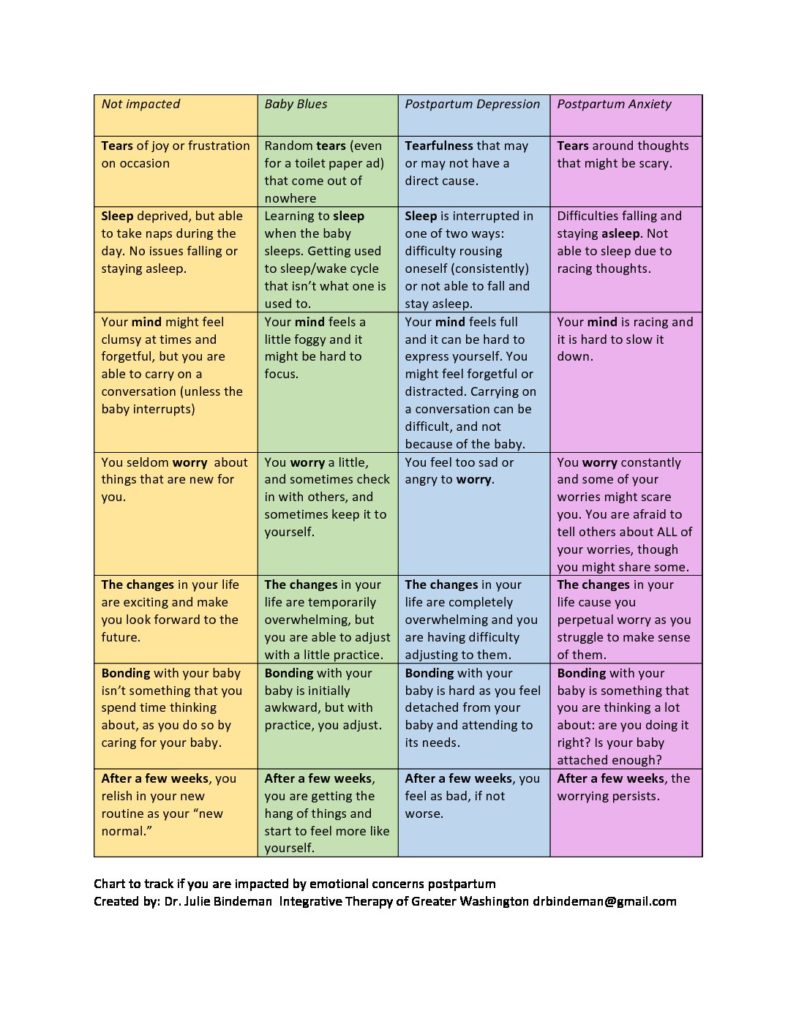
To clear up any misconceptions, here is my chart:


Not impacted Baby Blues Postpartum Depression Postpartum Anxiety
Tears of joy or frustration on occasion Random tears (even for a toilet paper ad) that come out of nowhere Tearfulness that may or may not have a direct cause. Tears around thoughts that might be scary.
Sleep deprived, but able to take naps during the day. No issues falling or staying asleep. Learning to sleep when the baby sleeps. Getting used to sleep/wake cycle that isn’t what one is used to. Sleep is interrupted in one of two ways: difficulty rousing oneself (consistently) or not able to fall and stay asleep. Difficulties falling and staying asleep. Not able to sleep due to racing thoughts.
Your mind might feel clumsy at times and forgetful, but you are able to carry on a conversation (unless the baby interrupts) Your mind feels a little foggy and it might be hard to focus. Your mind feels full and it can be hard to express yourself. You might feel forgetful or distracted. Carrying on a conversation can be difficult, and not because of the baby. Your mind is racing and it is hard to slow it down.
You seldom worry  about things that are new for you. You worry a little, and sometimes check in with others, and sometimes keep it to yourself. You feel too sad or angry to worry. You worry constantly and some of your worries might scare you. You are afraid to tell others about ALL of your worries, though you might share some.
The changes in your life are exciting and make you look forward to the future. The changes in your life are temporarily overwhelming, but you are able to adjust with a little practice. The changes in your life are completely overwhelming and you are having difficulty adjusting to them. The changes in your life cause you perpetual worry as you struggle to make sense of them.
Bonding with your baby isn’t something that you spend time thinking about, as you do so by caring for your baby. Bonding with your baby is initially awkward, but with practice, you adjust. Bonding with your baby is hard as you feel detached from your baby and attending to its needs. Bonding with your baby is something that you are thinking a lot about: are you doing it right? Is your baby attached enough?
After a few weeks, you relish in your new routine as your “new normal.” After a few weeks, you are getting the hang of things and start to feel more like yourself. After a few weeks, you feel as bad, if not worse. After a few weeks, the worrying persists.


by ITGW
Tags: anxiety, baby blues, bonding, depression, feelings, how to know, mood issues, postpartum, sleep, worry
Share this entry
  • Share on Facebook
  • Share on X
  • Share on WhatsApp
  • Share on Pinterest
  • Share on LinkedIn
  • Share on Tumblr
  • Share on Vk
  • Share on Reddit
  • Share by Mail
https://greaterwashingtontherapy.com/wp-content/uploads/2018/08/Postpartum-Chart-pdf.jpg 1408 1088 ITGW https://greaterwashingtontherapy.com/wp-content/uploads/2017/08/logo-300x84.png ITGW2018-08-21 00:06:562018-08-21 00:06:56Understanding Perinatal Mood Issues–When is it a Problem?
You might also like
I’m a Reproductive Psychologist: but I’m not on the Zulresso bandwagon

Recent Posts

  • Kids, Covid-19 and Nightmares
  • I’m a Reproductive Psychologist: but I’m not on the Zulresso bandwagon
  • Understanding Perinatal Mood Issues–When is it a Problem?
  • Managing Weight During Vacation
  • The “C” Word

Archives

  • June 2020
  • March 2019
  • August 2018
  • June 2018
  • April 2018
  • January 2018
  • December 2017
  • August 2017

Office Hours

Mo-Fr: 8:00-19:00
Sa: 8:00-14:00
So: closed

Link to: Managing Weight During Vacation Link to: Managing Weight During Vacation Managing Weight During Vacation Link to: I’m a Reproductive Psychologist: but I’m not on the Zulresso bandwagon Link to: I’m a Reproductive Psychologist: but I’m not on the Zulresso bandwagon I’m a Reproductive Psychologist: but I’m not on the Zulresso ba...
Scroll to top Scroll to top Scroll to top

This site uses cookies. By continuing to browse the site, you are agreeing to our use of cookies.

OKLearn more

Cookie and Privacy Settings


How we use cookies

We may request cookies to be set on your device. We use cookies to let us know when you visit our websites, how you interact with us, to enrich your user experience, and to customize your relationship with our website.

Click on the different category headings to find out more. You can also change some of your preferences. Note that blocking some types of cookies may impact your experience on our websites and the services we are able to offer.

Essential Website Cookies

These cookies are strictly necessary to provide you with services available through our website and to use some of its features.

Because these cookies are strictly necessary to deliver the website, refusing them will have impact how our site functions. You always can block or delete cookies by changing your browser settings and force blocking all cookies on this website. But this will always prompt you to accept/refuse cookies when revisiting our site.

We fully respect if you want to refuse cookies but to avoid asking you again and again kindly allow us to store a cookie for that. You are free to opt out any time or opt in for other cookies to get a better experience. If you refuse cookies we will remove all set cookies in our domain.

We provide you with a list of stored cookies on your computer in our domain so you can check what we stored. Due to security reasons we are not able to show or modify cookies from other domains. You can check these in your browser security settings.

Other external services

We also use different external services like Google Webfonts, Google Maps, and external Video providers. Since these providers may collect personal data like your IP address we allow you to block them here. Please be aware that this might heavily reduce the functionality and appearance of our site. Changes will take effect once you reload the page.

Google Webfont Settings:

Google Map Settings:

Google reCaptcha Settings:

Vimeo and Youtube video embeds:

Accept settingsHide notification only